
 English
 Español
Content
Why Aluminum Dominates Motor Housing Design
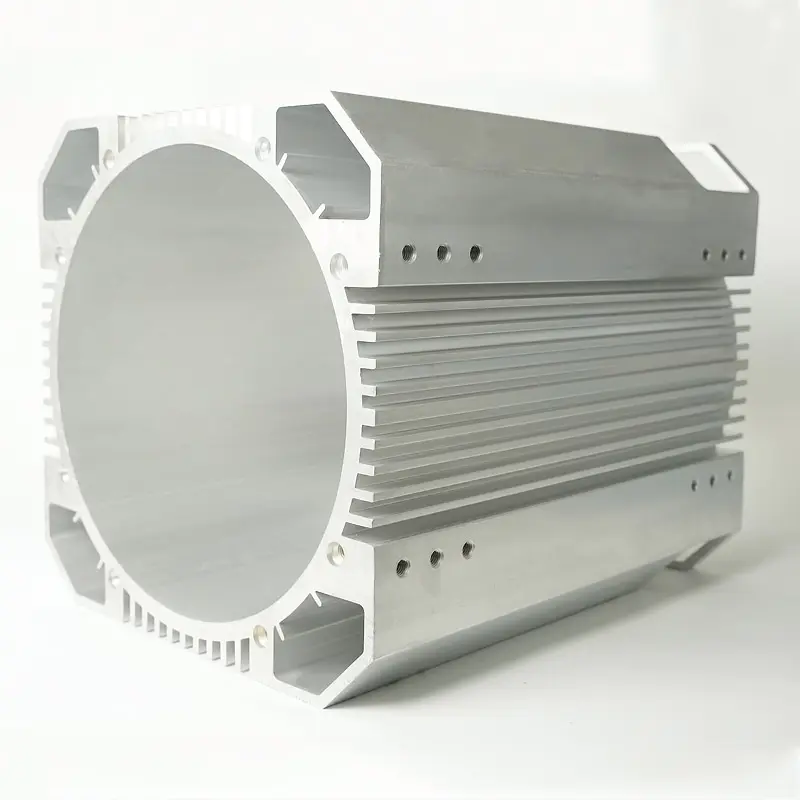
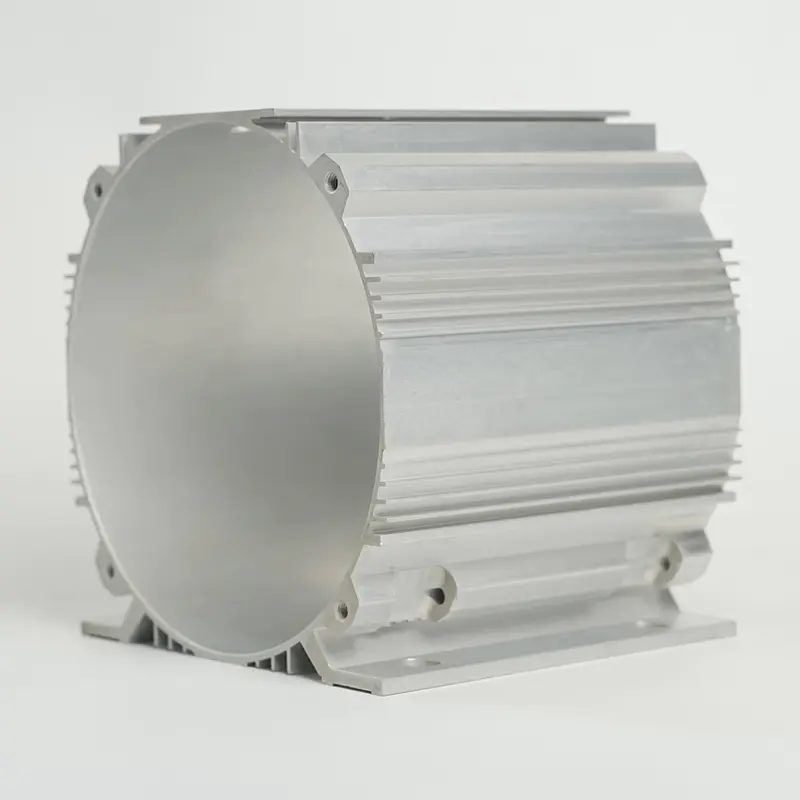
Aluminum has become the material of choice for motor housings across industries ranging from automotive to industrial automation. The reason is straightforward: aluminum delivers a combination of thermal conductivity, structural strength, and weight reduction that no other common engineering metal can match at the same cost point. A typical aluminum motor housing weighs roughly one-third as much as a comparable cast iron enclosure, yet maintains sufficient rigidity to contain vibration and protect internal windings under continuous load.
Thermal performance is a primary driver in material selection. Aluminum alloys used in motor housings typically achieve thermal conductivity values between 150 and 205 W/m·K, compared to approximately 50 W/m·K for gray cast iron. This difference is decisive in high-cycle or high-duty-rate applications where heat buildup directly shortens winding insulation life. Engineers consistently specify aluminum when the motor frame must double as a heat dissipation surface, particularly in enclosed or IP-rated designs where fins on the exterior housing are the only practical cooling path.
Corrosion resistance is a secondary but important advantage. Bare aluminum forms a stable oxide layer in ambient conditions, making it serviceable in many environments without additional surface treatment. For more aggressive conditions — wash-down zones, coastal installations, or chemical processing facilities — anodized or powder-coated aluminum housings offer protection that is both lighter and more easily maintained than coated iron alternatives.
Alloy Selection and Mechanical Properties
Not all aluminum performs equally in motor housing applications. The majority of housings are produced from either die-cast alloys such as A380 and ADC12, or wrought alloys such as 6061-T6, depending on the manufacturing route and mechanical requirements.
| Alloy | Tensile Strength (MPa) | Thermal Conductivity (W/m·K) | Common Process |
|---|---|---|---|
| A380 | 310–330 | 96 | High-pressure die casting |
| ADC12 | 300–320 | 92–100 | High-pressure die casting |
| 6061-T6 | 276–310 | 167 | Extrusion / machining |
| A356-T6 | 228–262 | 151–159 | Sand / gravity casting |
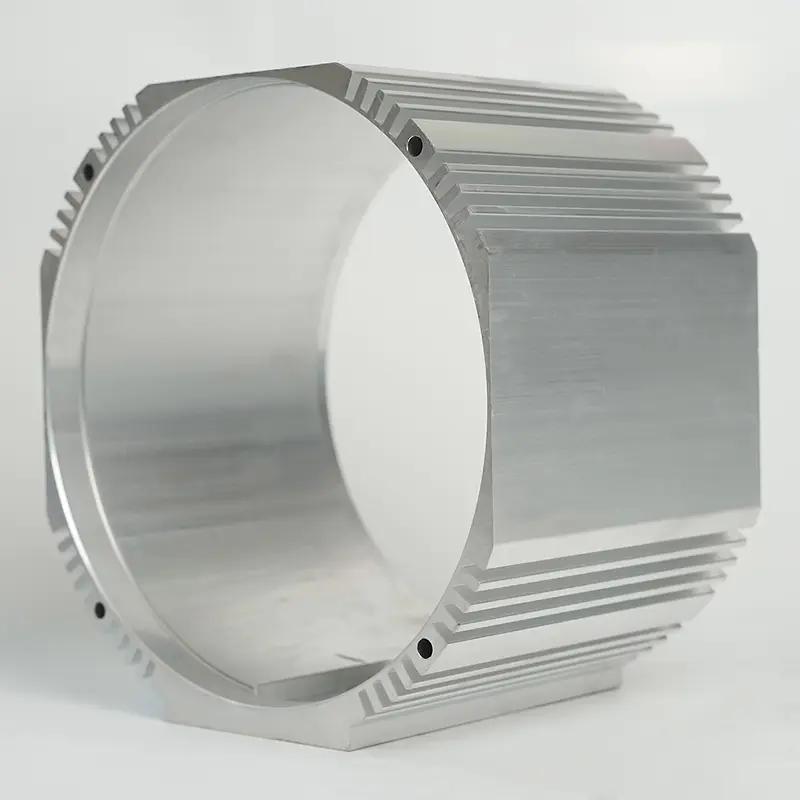
Die-cast alloys such as A380 dominate high-volume production because they allow complex geometries — including integrated cooling fins, bearing seats, and conduit bosses — to be produced in a single shot with minimal secondary machining. The trade-off is lower thermal conductivity relative to wrought alloys, a factor that becomes significant in compact, high-power-density motors. For servo motors, spindle motors, and other precision applications, 6061-T6 machined from billet or extrusion is often preferred due to its superior dimensional stability and higher conductivity, even though per-unit costs are higher.
A356-T6 sand castings occupy a middle ground, offering better thermal performance than standard die-casting alloys and the ability to produce housings in low volumes without expensive tooling. They are commonly specified for large-frame motors — IEC frame sizes above 200 — where die casting becomes impractical due to machine capacity limits.
Manufacturing Processes and Dimensional Tolerances
The manufacturing route for an aluminum motor housing has a direct impact on wall thickness capability, surface finish, dimensional repeatability, and ultimately the precision of bearing register fits and stator bore concentricity. Three processes account for nearly all production volume:
- High-pressure die casting (HPDC) — suited for housings in the sub-15 kg range, capable of wall thicknesses as low as 2.5 mm, with cycle times under 60 seconds. Post-cast machining is required on bearing seats and mating flanges to achieve fits in the H7/p6 or H7/k6 range.
- Gravity die casting and low-pressure casting — used for medium-volume production where porosity control is more critical, such as in motor housings for inverter-duty or wash-down-rated motors. These processes produce denser castings that respond better to pressure testing.
- CNC machining from extrusion or billet — the highest-precision route, used for servo motor housings and encoder-mounted designs where concentricity tolerances are below 0.02 mm TIR. Lead times are longer and material utilization lower, but the resulting housings support tighter bearing preloads and lower vibration.
Regardless of process, the stator bore and end shield spigot fits are the most dimensionally critical features. Out-of-round stator bores increase core loss and generate audible noise in finished motors; most motor standards call for bore roundness within 0.03–0.05 mm for motors under 5 kW. Achieving this consistently in die-cast housings requires dedicated finish-boring operations on balanced fixtures after aging or stress relieving the casting.
Cooling Fin Design and Thermal Management
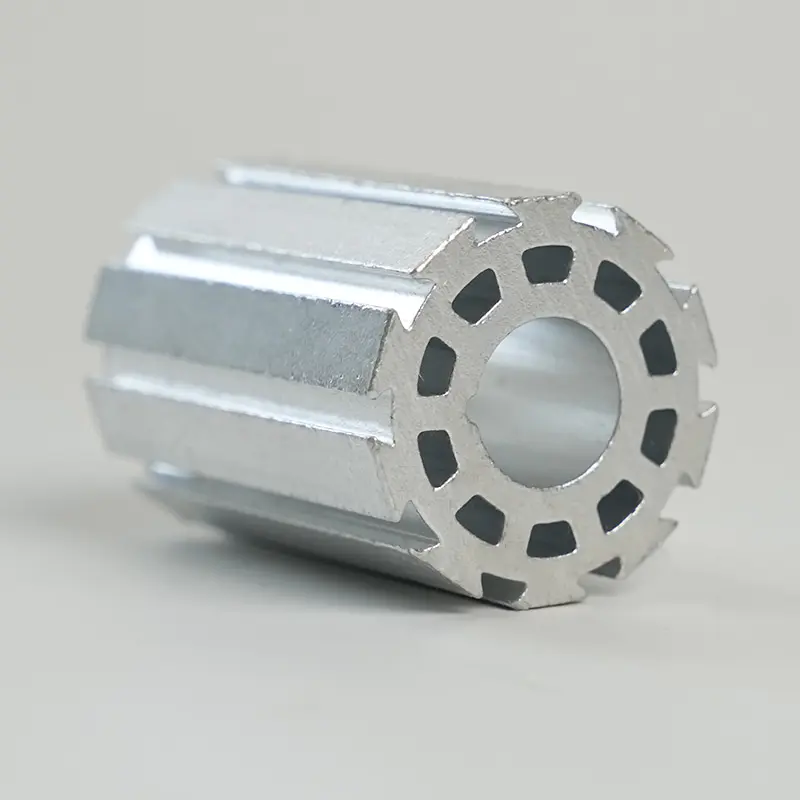
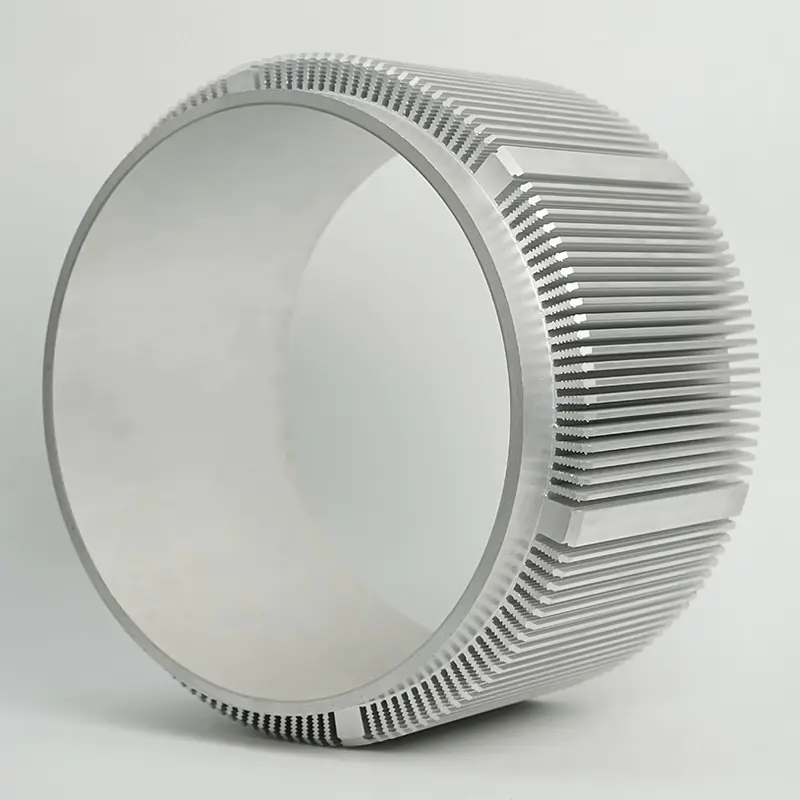
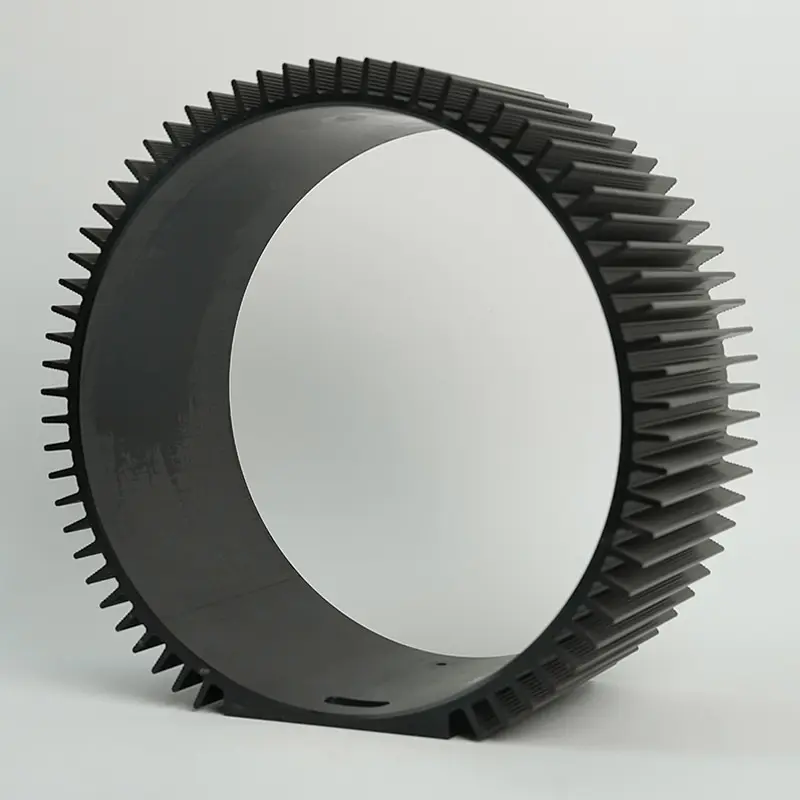
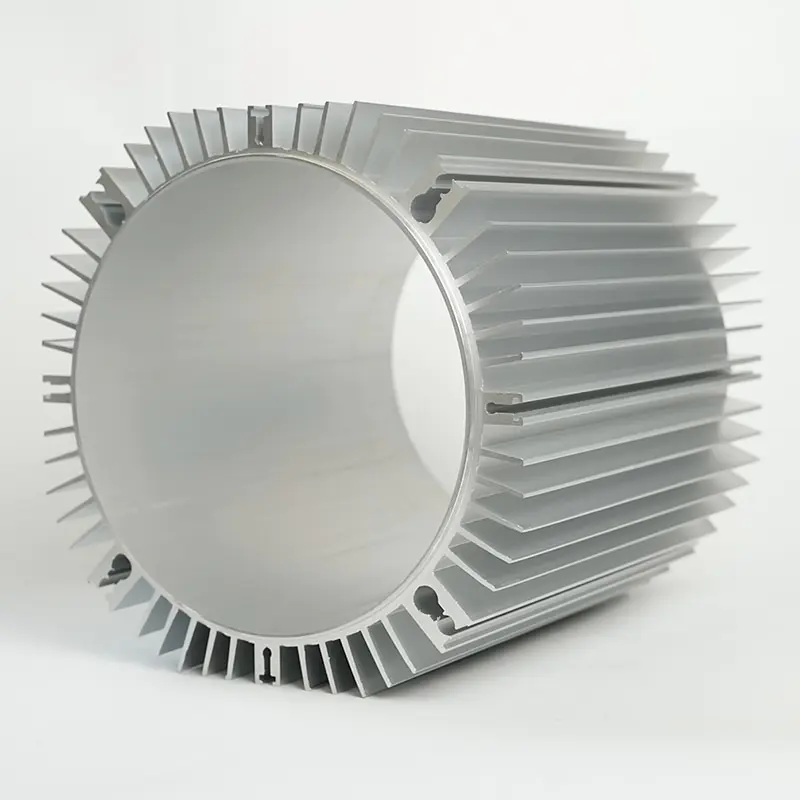
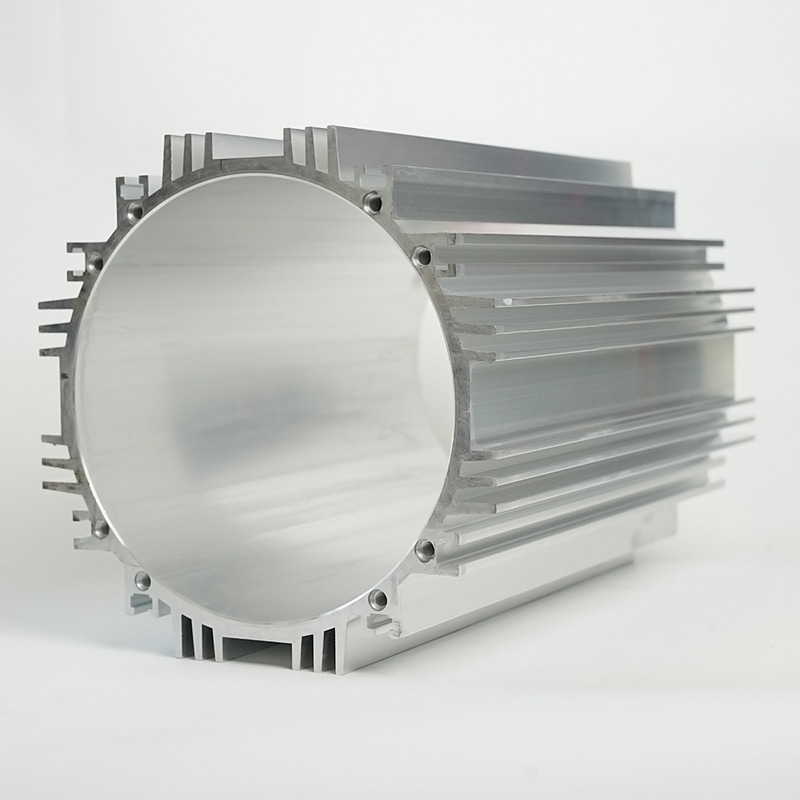
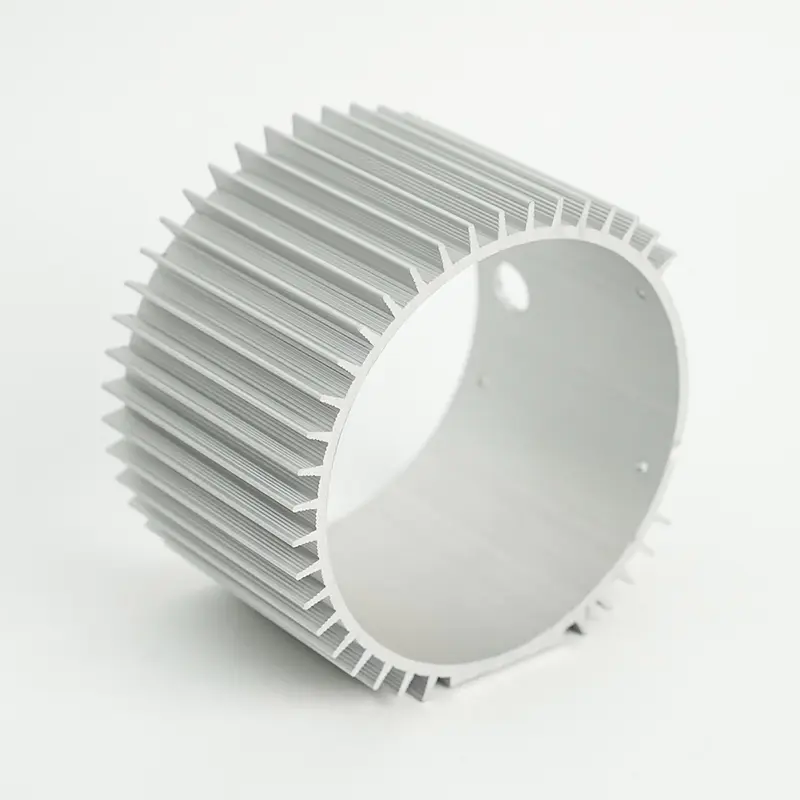
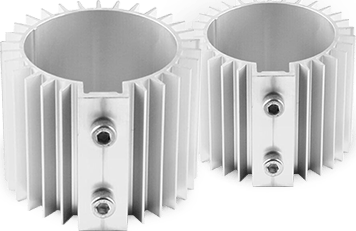
The geometry of cooling fins on an aluminum motor housing directly determines how effectively the motor can shed heat under continuous duty. Standard TEFC (totally enclosed fan-cooled) motors use longitudinal fins that run the length of the frame, oriented to align with the airflow from the external cooling fan. Key design parameters include fin pitch, height-to-thickness ratio, and the base wall thickness between the fin root and the stator lamination stack.
Typical longitudinal fin arrangements on NEMA or IEC frame motors follow these general guidelines:
- Fin pitch: 6–12 mm center-to-center; tighter pitch increases surface area but restricts airflow in contaminated environments
- Fin height: typically 15–30 mm; taller fins add surface area but reduce structural stiffness and increase the risk of resonance
- Base wall thickness: 5–10 mm, serving as the primary conduction path from stator OD to fin root
For liquid-cooled motors — increasingly common in EV traction, machine tool spindles, and high-cycle servo applications — the housing incorporates an integral cooling jacket rather than external fins. These water-jacket housings use aluminum's castability to form helical or axial coolant passages inside the housing wall, typically with inlet and outlet ports at opposite ends. Jacket designs can reduce thermal resistance between the stator and coolant by 60–75% compared to air-cooled configurations, enabling significantly higher power density within the same frame size.
Surface Treatment, IP Rating, and Service Life
Bare aluminum motor housings are adequate for indoor, non-corrosive environments, but most industrial applications require additional surface treatment to meet IP protection ratings, UL or CE certification requirements, or operating life targets in harsh conditions. The most common treatments applied to aluminum motor housings include:
- Powder coating — cost-effective for volumes above 500 units, provides 60–80 µm coating thickness, and passes standard salt spray tests to ASTM B117 at 500–1000 hours depending on primer selection. The most common choice for general industrial motors.
- Hard anodizing (Type III) — builds an aluminum oxide layer up to 25–50 µm deep into the surface, offering excellent abrasion resistance. Used on housings exposed to mechanical contact, sliding wear, or moderate chemical exposure. Does not provide the same sealing performance as powder coat at O-ring grooves and conduit entries without additional sealing.
- Chromate conversion coating (Alodine/Iridite) — a thin, conformal coating primarily used as a primer adhesion layer before painting, or as a standalone treatment where electrical conductivity through the housing surface must be maintained (grounding applications, EMC-shielded motors).
- Epoxy or polyurethane paint systems — used on motors destined for wash-down (IP55/IP65/IP69K) or chemical plant environments, often applied as two-coat systems with a zinc-rich primer for maximum corrosion protection.
IP rating compliance depends not only on the surface treatment but on the gasket and seal system at end shields, conduit entries, and drain plugs. IP55-rated aluminum motor housings are the most common specification in general industrial markets, providing protection against dust ingress and water jets from any direction. IP65 and IP66 ratings extend protection to powerful water jets, and IP69K — required in food processing and pharmaceutical applications — mandates resistance to high-pressure, high-temperature steam cleaning.
Properly designed and finished aluminum motor housings typically achieve service lives exceeding 20 years in standard industrial environments when bearing replacement schedules are followed. The housing itself rarely fails structurally; the limiting factor in most cases is bearing seat wear from repeated bearing changes, which is why hard-anodized or sleeved bearing bores are specified for motors expected to exceed five bearing change cycles.